ScalePlane · Own product

A platform for AI agents. Built with AI agents.

My interpretation of a software factory: workflows structure the work, triggers start it and agents handle tasks. I set the direction, review results and develop the platform further.

Software factory

From a task to a verifiable change.

Built as a solo developer with AI agents. ScalePlane connects the individual steps into a system I use to develop the product itself.

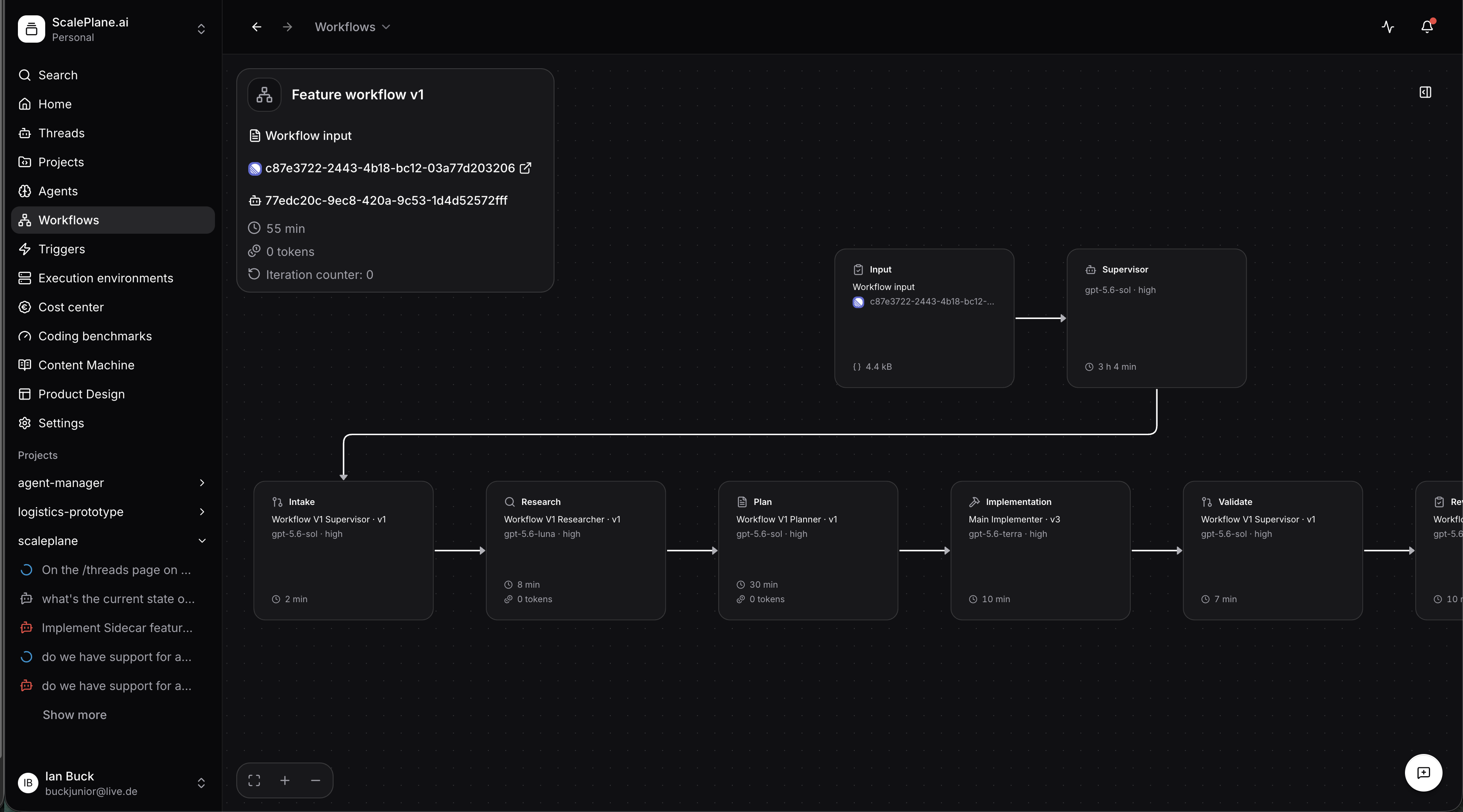
ScalePlane showing a feature workflow: a supervisor coordinates agents for intake, research, planning, implementation and validation. The workflow continues to the right.
Inside a feature workflow: specialised agents implement and review a change. Click to enlarge.
  1. 01

    Trigger

    A task or trigger starts the work.

  2. 02

    Coordinate

    A workflow provides tasks and context.

  3. 03

    Execute

    Agents work with code and tools.

  4. 04

    Verify

    Tests and results make changes verifiable.

  5. 05

    Approve

    I review the changes and decide on the next step.

Simplified workflow: a task starts a workflow; agents carry it out, results are checked and I approve them.

Currently in pre-release and used in my daily development work.

Project in numbers

A substantial system.

Stand 20.09.2026: ein gemeinsamer Snapshot von Code und Entwicklungshistorie.

Lines of source code
486,044

Applications and libraries

Lines of tests & test data
230,566

Tests and associated fixtures

Lines of generated code
869,798

Counted separately

Merged pull requests
939

Integrated changes

Development commits
2,231

Excluding merge commits

How are the figures counted?

The count covers ScalePlane’s code. Source code includes human and AI-assisted development. Tests, test data and generated files are reported separately. Blank lines, comments, dependencies, third-party code and build output are excluded from source code.

A further 51,825 lines of tooling and infrastructure code are counted separately and excluded from the source-code figure. The count also includes older product components that remain in the codebase.

Development history is counted without duplication. Merge commits, migration-only changes and changes outside the product are excluded from the respective totals. Pull requests and commits are different measures.

Counted with scc 4.1.0 on 2026-09-20. Source revision: 6565e7737057. The figures show scope and development history, not productivity or quality.
Brownfield, not a blank project

New ideas meet an existing system.

ScalePlane grows in an environment where models and agent tools change constantly. Existing features still need to work together: interface, API, database, agent runtimes, workflows and integrations.

That is brownfield development: changing a system with existing rules, data and dependencies. A new feature often touches several parts at once — from the data model to displaying a running task.

I see first-hand how well agents handle large codebases, what context they lack and which checks make changes reliable.

Engineering

What makes agentic work possible.

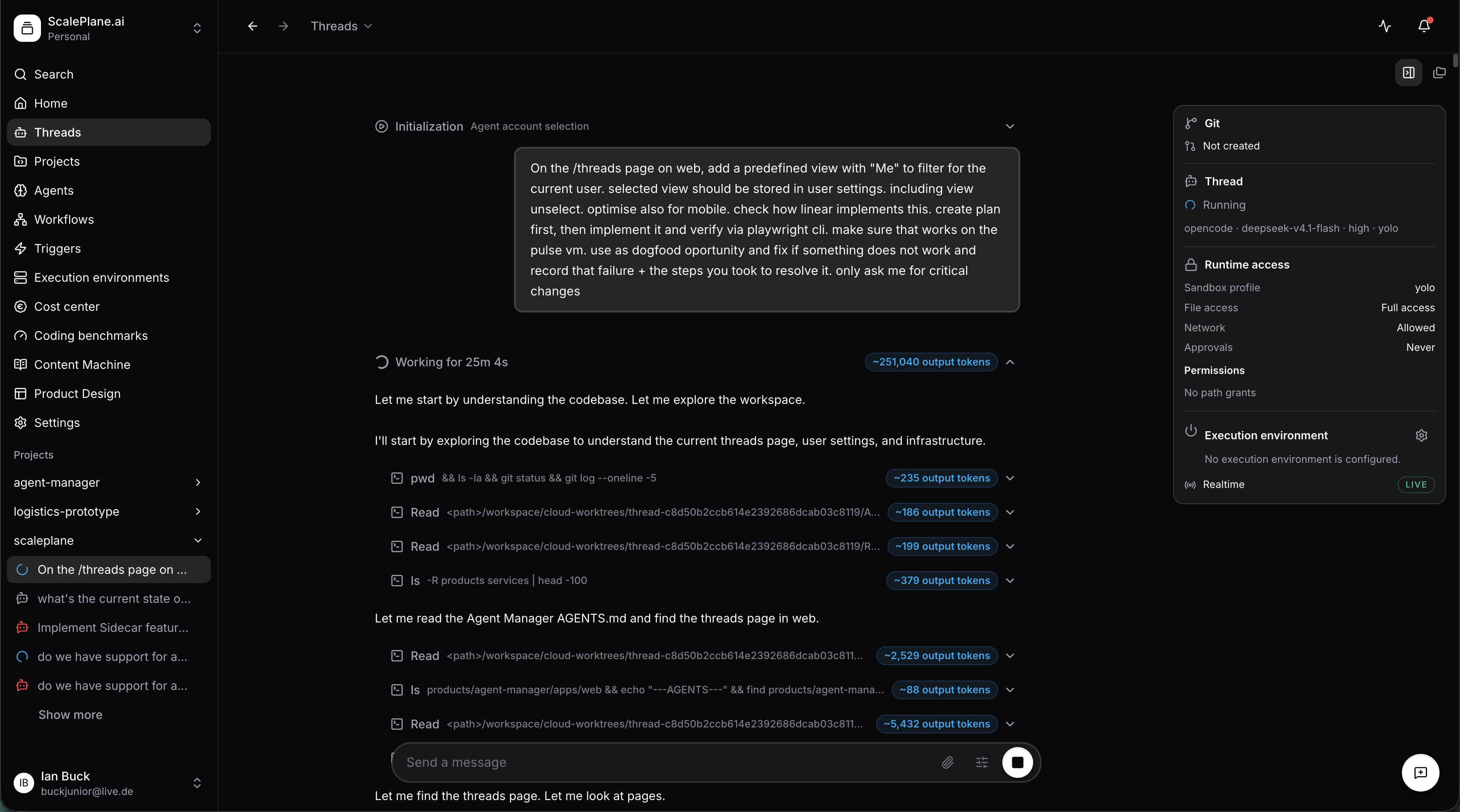
ScalePlane chat showing a task, running tool calls and a sidebar with thread status, agent runtime and access permissions.
Agents at work in chat: the task and tool calls remain visible. The sidebar shows the selected runtime and its permissions. Click to enlarge.

Agents and their working environment

A model alone does not deliver a project. It needs context, tools and a reliable workflow. In ScalePlane, this environment — the harness — connects different agent runtimes with tasks, repositories and traceable results.

  • Codex
  • Claude
  • OpenCode

Sandboxes and access

Agents need an environment where they can actually work. That includes provisioning and cleaning up sandboxes, assigned access and handling secrets. The code implements separate credentials and masking of known secrets in output, among other measures.

  • Execution environments
  • Secret management
  • Lifecycle

Resume rather than restart

Long tasks involve dropped connections, restarts and new instructions. Persisted state, recovery and verifiable results are therefore dedicated parts of the system. This is where the realities of working with agents become apparent.

  • State
  • Recovery
  • Validation

Technology

From code to infrastructure.

The product also includes deployment, data storage, access and monitoring of running systems.

Backend and data

  • .NET
  • PostgreSQL

API, business logic, and persisted task and execution state.

Interface and agents

  • TypeScript
  • Vue
  • Bun

Web interface, tools and the runtime connecting agents to the platform.

Hosting and deployment

  • Hetzner
  • Docker

Servers, containers and configuration for running the platform.

Secrets and observability

  • Azure
  • Terraform
  • SigNoz

Azure Key Vault for infrastructure secrets, Azure Blob for Terraform state and Terraform for SigNoz dashboards.

Working with you

Experience from building every day.

I test what I build here myself — from the first agent task to running the platform. I bring that experience to your projects.

Together, we can clarify which tasks agents should handle, which tools and access they need, and how your team reviews the results. From the first experiment to integration with your existing IT.